
OpenAI Introduces ChatGPT Health for Private, Personalized Health Conversations
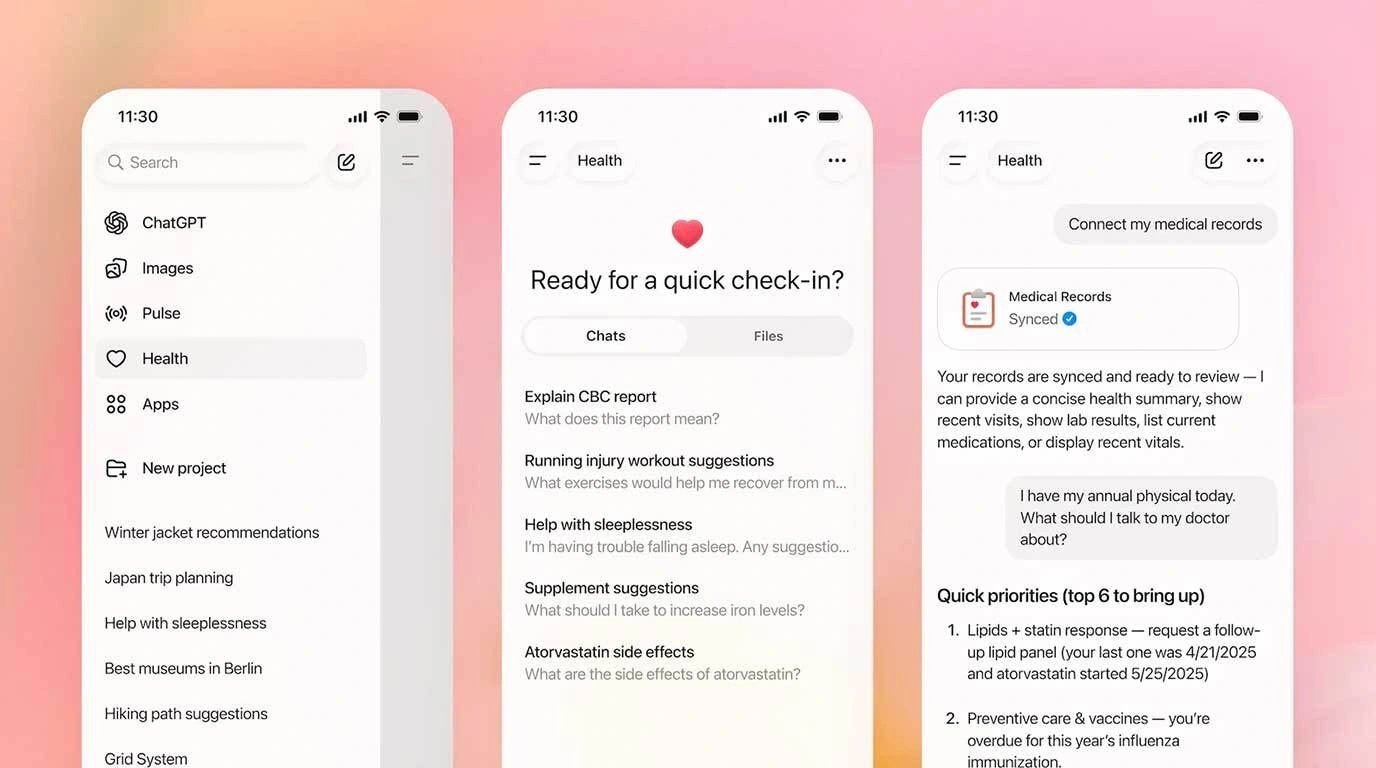
OpenAI has unveiled ChatGPT Health, a new experience inside ChatGPT designed to support more meaningful health conversations by securely incorporating users’ own medical records and fitness data.
Unlike generic symptom checkers or one-size-fits-all advice, ChatGPT Health is built around personal context, while promising stronger privacy protections than standard chatbot interactions.
What Is ChatGPT Health?
ChatGPT Health is a dedicated health-focused mode within ChatGPT that allows users to connect their personal wellness and medical data for more informed conversations.
Key capabilities include:
- Pulling in data from fitness and wellness platforms
- Importing clinical records from healthcare providers
- Isolating health chats from other ChatGPT conversations
This approach aims to help users ask more nuanced questions about symptoms, nutrition, exercise, medications, and insurance—without relying solely on generic guidance.
Data Sources and Integrations
At launch, ChatGPT Health supports connections with popular consumer health platforms, including:
- Apple Health
- MyFitnessPal
- Peloton
For clinical data, OpenAI is partnering with b.well, which enables users to import medical records directly from participating healthcare providers. Access to provider records is currently limited to users in the United States.
Privacy and Security Commitments
Given the sensitivity of health information, OpenAI is positioning privacy as a central feature of ChatGPT Health:
- Health conversations are stored in a separate, isolated memory
- Data is protected with stronger encryption
- OpenAI states that health chats will not be used to train its models
These safeguards are meant to distinguish ChatGPT Health from general-purpose AI interactions and address long-standing concerns about medical data security.
What This Could Mean for Radiology and Imaging-Centered Care
While ChatGPT Health is not positioned as a diagnostic tool, its ability to securely ingest medical records has clear implications for radiology-driven healthcare, where imaging data often sits at the center of clinical decision-making.
Radiology workflows generate large volumes of structured and unstructured information—reports, follow-up recommendations, contrast histories, and longitudinal imaging timelines. A privacy-isolated AI interface that can reference this context may help patients:
- Better understand radiology reports written in highly technical language
- Track imaging histories across providers and health systems
- Prepare more informed questions ahead of radiology or oncology consults
- Clarify next steps after findings that require follow-up imaging
From a system-level perspective, tools like ChatGPT Health reflect a broader shift toward patient-facing access to radiology insights, not just images and PDFs. As imaging continues to anchor care pathways in cancer, cardiology, neurology, and emergency medicine, AI interfaces that sit on top of radiology data—rather than replacing radiologists—could improve continuity, comprehension, and adherence.
That said, the stakes are particularly high in imaging. Misinterpretation of findings, uncertainty around incidentalomas, and timing-sensitive follow-ups mean that any AI-mediated interaction must maintain strict boundaries between explanation and diagnosis.
For radiology, ChatGPT Health represents less of an automation play—and more of a signal that patient engagement around imaging data is becoming an AI-native experience.
How This Fits With OpenAI’s Broader Healthcare Strategy
ChatGPT Health arrives alongside a broader articulation of OpenAI’s healthcare ambitions outlined in the company’s January 2026 report, AI as a Healthcare Ally. In that report, OpenAI frames its role not as a clinical decision-maker, but as a support layer that helps patients navigate complex health systems, understand information, and engage more effectively with care.
One of the report’s key data points underscores why Health is emerging now: OpenAI says more than 40 million users already turn to ChatGPT daily for health-related questions, including symptom checks, insurance navigation, medication questions, and care coordination. Much of this activity has been happening informally, without structured safeguards or health-specific context.
ChatGPT Health can be seen as a response to that reality. Rather than discouraging health use cases, OpenAI is formalizing them with:
- Stronger privacy and encryption guarantees
- Isolated memory for sensitive health conversations
- Clear boundaries around training use and clinical authority
In the report, OpenAI emphasizes that AI’s near-term value in healthcare lies in augmentation, not automation—helping users prepare for appointments, interpret records, and follow care plans, while leaving diagnosis and treatment decisions to licensed professionals.
Viewed through that lens, ChatGPT Health is less a standalone product and more an infrastructure step: a way to align how people are already using AI for health with protections, intent, and guardrails that match the stakes of the domain.
Why OpenAI Is Moving Into Healthcare Now
According to OpenAI, more than 40 million users already use ChatGPT daily for health-related questions—ranging from symptom checks to insurance and care navigation.
ChatGPT Health formalizes that usage at a moment when AI tools are increasingly intersecting with regulated healthcare:
- AI-powered prescription refill systems are emerging
- Medical AI devices are gaining FDA attention and approvals
- Consumers are growing more comfortable managing health digitally
By launching Health now, OpenAI joins education and shopping as another major vertical—one with significantly higher stakes and regulatory scrutiny.
Availability and What Comes Next
- A waitlist opens today
- Broader web and iOS access is expected soon
- Full medical record imports are U.S.-only for now
OpenAI has not yet shared timelines for international expansion or additional clinical features.
The Bigger Picture
ChatGPT Health signals OpenAI’s ambition to become an everyday interface for managing complex, real-world domains. In healthcare, however, accuracy, trust, and accountability matter more than ever.
If OpenAI can balance personalization with privacy—and assistance with clear medical boundaries—ChatGPT Health could become a meaningful layer between patients, data, and the healthcare system itself.
Source: OpenAI, Introducing ChatGPT Health